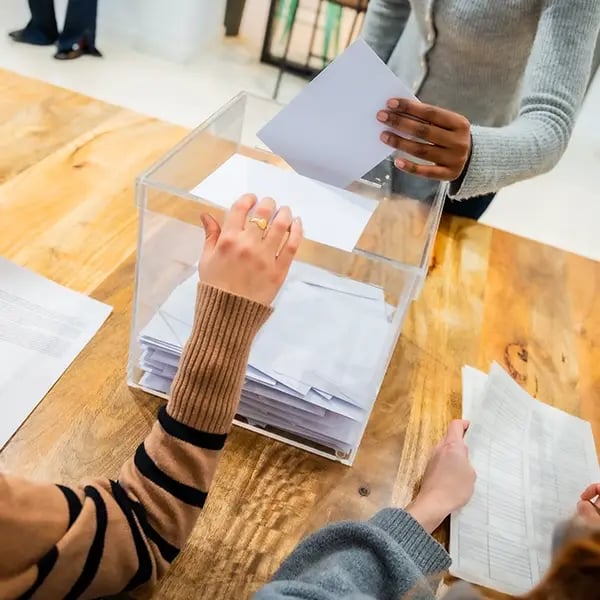
Organic Law 5/1985 on the General Electoral Regime (LOREG), Article 13 of Royal Decree 605/1999 and Article 37.3(d) of the Spanish Workers’ Statute establish the basic framework governing paid leave in these circumstances.
Paid leave to exercise the right to vote
Employees whose working hours coincide with polling hours may be entitled to up to four hours of paid leave. The entitlement is subject to Article 13.1 of Royal Decree 605/1999 and the terms established by the relevant Autonomous Community authority.
The leave is non-recoverable and may not result in a salary reduction for the legally recognised period, although the employee must subsequently provide evidence. Four hours is a maximum, not an automatic entitlement. The actual duration depends on the overlap between working hours and polling station opening hours and on the applicable authority’s provisions.
For reduced working hours, the leave is reduced proportionally. The company may determine when it is taken, having regard to operational requirements, while ensuring the employee can vote. Where there is no overlap, no paid absence is due. Companies should verify the rules applicable in each Autonomous Community.
Employees working away from their place of residence and postal voting
Employees who need to complete postal-voting formalities because they work away from their usual residence, or for other reasons preventing in-person voting, must be afforded organisational measures enabling up to four hours of paid leave during working hours to request the electoral registration certificate and submit the postal vote, subject to the applicable conditions.
Electoral Board Chairpersons and Members
Employees appointed as Chairpersons or Members are entitled to paid leave for the entire working day if scheduled to work on Sunday, 29 November. They are also entitled, in all cases, to a paid five-hour reduction on Monday, 30 November, even if Sunday is ordinarily a non-working day.
The reduction is taken on the working day immediately following the election. If Monday is not a working day, state legislation does not automatically transfer the entitlement; the applicable collective bargaining agreement should be reviewed. Resolution 200/2024 of the Central Electoral Commission indicates that the reduction should generally be taken at the beginning of the following working day. Another distribution requires agreement or collective bargaining and must remain within that day.
Alternate Electoral Board Members
Alternates must attend at 8:00 a.m. for constitution of the Electoral Board. If they replace a principal member, the same leave applies. If they do not take up a position, they must return to work once released, without prejudice to the fact that the time strictly necessary to fulfil this public duty is treated as paid leave.
Polling Agents and Electoral Representatives
Employees standing as candidates: in the private sector there is generally no specific paid leave. Unless a collective agreement provides otherwise, absences must be arranged through annual leave, unpaid leave or another agreed arrangement.
Polling agents (interventores): the same regime as Chairpersons and Members applies, including full paid leave on election day when scheduled to work and the five-hour reduction on Monday.
Electoral representatives (apoderados): paid leave applies during election day when scheduled to work, but there is no five-hour reduction on Monday.
Mandatory appointment and grounds for exemption
Appointment as Chairperson or Member is mandatory. Being required to work does not constitute grounds for exemption. The appointed individual has seven days from notification to submit a justified and documented excuse to the relevant Electoral Commission of the District. Subsequent impediments must be notified within the legally established requirements and time limits. Instruction 6/2011 recognises certain personal, family and professional grounds, which must be evidenced and accepted.
Business organisation and evidence of leave entitlements
Companies should identify Sunday-working positions, review appointments notified by employees, and anticipate absences and reductions on Monday, without interfering with electoral rights.
The employer may request proof of attendance for voting, evidence of appointment and effective service, evidence concerning an alternate, and polling-agent or electoral-representative credentials. Documentation must be limited to what is necessary and must never include information about voting choice.
Night shifts
Night shifts require case-by-case assessment. Under Central Electoral Commission criteria, the shift beginning on election day is treated as election-day working time, and the five-hour reduction may apply to the shift beginning the following day. Relevant regional rules should also be checked regarding changes to the preceding night shift to ensure adequate rest.